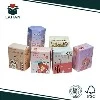
As a supplier of Brown Kraft Food Boxes, I've received numerous inquiries about the ease of assembling these boxes. In this blog, I'll share my insights based on years of experience in the industry, discussing the factors that contribute to the assembly process and whether brown kraft food boxes are indeed easy to assemble.
Material Characteristics
Brown kraft paper is a popular choice for food packaging due to its natural, eco - friendly appearance and excellent strength. Kraft paper is made from wood pulp, usually through a chemical pulping process that preserves the fibers' integrity. This results in a material that is both tough and flexible.


The inherent flexibility of brown kraft paper plays a crucial role in the assembly process. It can be easily bent and folded along the pre - scored lines. Unlike some rigid plastics or thick cardboard materials, kraft paper doesn't crack or break when folded at sharp angles. This makes it possible for anyone, even those with limited packaging experience, to assemble the boxes without much difficulty.
For example, when you receive a flat - packed brown kraft food box, you can simply follow the creases to form the base, sides, and top of the box. The paper's ability to hold its shape after folding ensures that the box retains its structure once assembled.
Design Features
The design of brown kraft food boxes is often optimized for easy assembly. Many of these boxes come with pre - cut and pre - scored lines. These lines act as guides, indicating exactly where to fold and how to construct the box. The scoring process weakens the paper along the intended folding lines, making it easier to create clean, sharp folds.
Some brown kraft food boxes also feature interlocking tabs or flaps. These design elements eliminate the need for additional adhesives or fasteners. You can simply insert the tabs into the corresponding slots or tuck the flaps under one another to secure the box. This not only simplifies the assembly process but also makes the boxes reusable and recyclable.
For instance, a common design for a rectangular brown kraft food box may have flaps on the sides that can be folded inwards and then locked together. The user doesn't need to use glue or tape; instead, they can rely on the natural friction between the interlocking parts to keep the box intact.
Assembly Steps
Let's break down the typical assembly steps of a brown kraft food box to see how straightforward the process is.
First, you start by laying out the flat - packed box on a clean, flat surface. Identify the base of the box, which is usually the largest panel. Next, fold along the pre - scored lines to form the sides of the box. This step is usually intuitive, as the creases are clearly visible.
After forming the sides, you can move on to closing the bottom of the box. If the box has interlocking tabs, insert them into the appropriate slots. This should create a stable base for the box.
Finally, assemble the top of the box. Some boxes may have a simple flap - closure system, where you fold the flaps over the open top and tuck them in. Others may have a more elaborate design, such as a lid that slides on or a locking mechanism.
Overall, the assembly steps are easy to follow, and with a bit of practice, you can assemble a brown kraft food box in just a few minutes.
Comparing with Other Packaging Options
When compared to other types of food packaging, brown kraft food boxes have a clear advantage in terms of assembly.
Plastic food containers often require complex snap - fit mechanisms or the use of adhesives to assemble. These processes can be time - consuming and may require some force to ensure a proper fit. In addition, plastic can be brittle, and there is a risk of the container cracking during assembly.
Cardboard boxes made from non - kraft materials may also pose challenges. Some of these boxes may be thicker and less flexible, making it difficult to create sharp folds. They may also require the use of tape or glue, which adds an extra step to the assembly process.
In contrast, brown kraft food boxes offer a simple, hassle - free assembly experience.
Applications and Benefits of Easy Assembly
The ease of assembling brown kraft food boxes has significant implications for various applications.
For food businesses, easy - to - assemble boxes mean increased efficiency. Staff can quickly assemble the boxes as needed, reducing the time spent on packaging. This is especially important during peak business hours when speed is of the essence.
Consumers also benefit from the easy assembly. If they receive a flat - packed brown kraft food box, they can assemble it at home without the need for special tools or skills. This makes it convenient for storing or transporting food items.
Moreover, the recyclability of brown kraft paper adds to the appeal of these boxes. Once the food has been consumed, the box can be easily disassembled and recycled, contributing to a more sustainable packaging solution.
Related Product Links
If you're interested in other types of packaging products, we also offer Kraft Cardboard Gift Boxes, Paper Gift Box For Sea Food, and Popular Easy To Take Shoes Clothing Box. These products also feature similar advantages in terms of easy assembly and eco - friendliness.
Contact for Purchase and Negotiation
If you're considering purchasing brown kraft food boxes for your business or personal use, I encourage you to get in touch. Our team is ready to discuss your specific requirements, provide samples, and offer competitive pricing. We believe that our high - quality, easy - to - assemble brown kraft food boxes will meet your packaging needs and exceed your expectations.
References
- Packaging World. (2023). Trends in Sustainable Food Packaging.
- Paper and Packaging Board. (2022). The Benefits of Kraft Paper Packaging.
- Food Packaging Magazine. (2021). Comparing Packaging Materials for Food Applications.