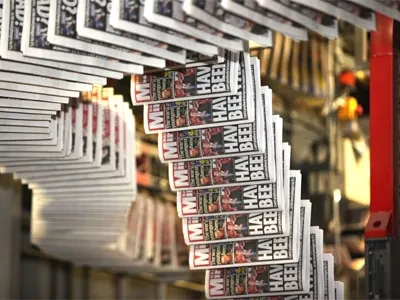
After a difficult period, offset printing has returned to a relatively stable state. Offset printing press sales have increased slightly at a stable level, and the equipment has reached the point where it can compete with digital printing even on smaller orders, and continues to attract interest from commercial printers. However, the market situation faced by high-efficiency and automated offset presses is that the number of low value-added prints continues to decline, resulting in a decrease in the total print volume of the offset printing market.
With the reduction of a large number of long orders with low added value and high printing volume, high added value and low printing volume orders have driven the development of production-oriented inkjet technology, and Drupa is also the best way to understand the new development of inkjet technology.
Production-oriented inkjet technology in the fields of securities, direct mail, and book printing has passed the early stage of use, and it is imperative to continue to develop creative ink materials that can make inkjet technology adapt to more substrates, thus expanding the scope of application of inkjet printing.
It is worth noting that pigment technology continues to flourish. HP Indigo's sales announcement was the main news at the show, with orders for at least 50 more Indigo12000 units to be delivered that year. Shutterfly and Cimpress, the parent company of Vistaprint, also announced a significant investment in Indigo at the show.
HP also demonstrated the combination of Indigo, cold pressing, and dynamic glossy coating on-line system, showing the possibility of coexistence of multiple printing technologies.
No Drupa would be complete without Landa's involvement, and although mass production may still be a few years away, Landa certainly piqued the interest of almost all attendees. Perhaps somewhat unexpected, but the Landa intermediate transfer tape inkjet method has been verified in Canon, Canon also exhibited B2 format with the use of intermediate transfer tape inkjet printing concept models.
Drupa shows that we are ready to enter an era of innovation and expansion in digital printing, in which ink innovation is the key to success. This is probably the most exciting time in the history of the printing industry.
Trends in inkjet technology
One of the main themes of Drupa is innovation in inkjet inks. At its core is the ability to inkjet print on a wider range of substrates, especially for document/image and packaging applications.
Almost all water-based inkjet inks at the show claim to be able to print on offset gloss coating consumables, and some manufacturers have introduced the concept of mixed inks to combine UV-curable inks with water-based inks.
Although the market hopes to have a universal ink, can guarantee consistent printing on all substrates. But in fact, universal ink can not be achieved, just like in the traditional printing field, ink is also a hundred flowers.
Uv-curable inks may be the closest universal ink to the definition of universal ink, but the cost and safety issues associated with UV-curable inks have also turned off some potential customers. Most of the new water-based inks are still in the early stages of development and can only be printed on "certified" coated offset printing supplies or film bases.
Application trend
Drupa shows a number of digital printing equipment for packaging applications, and claims to be able to print on non-porous substrates. Printers of toner and ink inkjet equipment have exhibited applications for folding cartons, flexible packaging, and corrugated packaging. We have seen the shift of digital printing from the label printing field and gradually differentiate into a mature competitive market.
The main reason why manufacturers are entering the digital packaging and printing field is that packaging is one of the few printing applications that is not threatened by social media technology. On the other hand, packaging is basically printed on one side, which is technically easier to achieve. There is another potential consideration: timeliness.
We are in the initial stages of the migration of packaging products from traditional printing to digital printing. This also means that the business development curve will be very slow, and further research and development and perfect digital printing technology will take time to emerge.
A very big challenge is how to convince the existing large manufacturers and packaging processors to disrupt their existing workflows and switch to higher value-added creative work. Throughout the past, packaging printers have adapted to traditional processing processes, and printed products are mostly low value-added packaging components.
With the help of digital printing, the packaging ecosystem can create more added value through simple printing, while reducing printing costs in the packaging production process. In terms of product added value, this means that FMCG manufacturers can create higher value for more short orders. But the adjustment is not the printing process itself, more in the downstream link. Even if manufacturers can quickly complete packaging printing and complete packaging, it does not mean that they can promote sales faster, not to mention that giving consumers too much choice does not necessarily lead to more product sales.
The process of creating added value by disrupting existing business models is long and painful. This means that companies that focused early on laying out the digital packaging industry may have to focus on process cost savings. This also increases the uncertainty of pre-printing or post-printing in corrugated printing, for example, or whether it needs to match the existing wired process flow or can be integrated into the offline workflow of the manufacturing process.
But it is more gratifying that all these digital printing into the field of packaging depict the future of value-added creation and process cost savings. We still have a lot of time to sink down and develop before the next Drupa show.
order
As for Drupa's biggest winner, there are many opinions. "Encouraged by the successful completion of public trials, Cimpress intends to purchase at least 20 Landa presses for global distribution," Landa said in a statement on its first day at Drupa.
A day later, HP was not to be outdone: "HP Indigo's largest customer in the world has agreed to buy the next generation of larger HP Indigo presses (about 20, more than half of which will be installed that year)."
HP later said it had received orders for more than 50 Indigo12000 units within a week of the show, most of which would be installed before the peak printing season.
But not all manufacturers are keen to publicize their sales. It appears that many more orders have not been publicly released.
epilogue
It is clear that the baton has passed from traditional printing to digital printing. As Benny Landa concluded at the closing: "Drupa will be remembered as the turning point from traditional to digital printing... It seems that market leaders in packaging, commercial printing and publishing need to realize that they must transform to digital."
Drupa has set the benchmark for the next stage of innovation and expansion in digital printing. Whether the ink can be printed on a wider range of substrates directly relates to the success or failure of the future. We pray that the focus of future business models will eventually shift from low-end pages to more competitively priced and value-added products. With the further innovation of technology and the improvement of the industry's understanding of digital printing, I believe that four years later Druba will be the most wonderful one.